


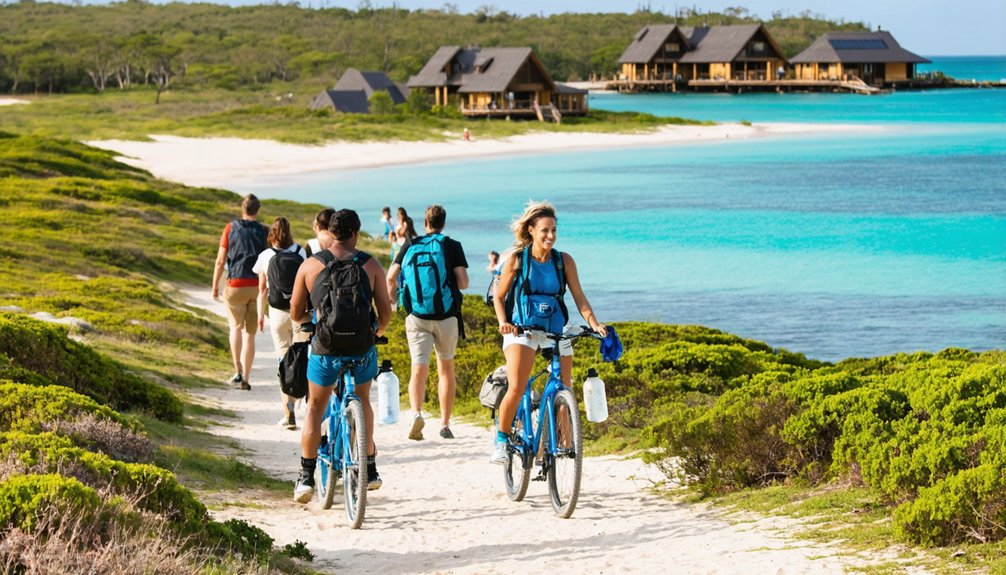
Sustainable tourism is growing globally because demand, economics, and policy now align. Most travelers say sustainability matters, and many will pay more for eco-certified stays, which already earn higher booking rates. The market is expanding at double-digit rates as destinations protect nature, spread visitors beyond crowded hotspots, and use digital tools to cut emissions and improve transparency. Governments and major travel brands are also backing lower-impact models, with the broader shift and emerging opportunities explained ahead.
Highlights
- Travelers increasingly expect sustainable options, with 83–87% saying it matters and many willing to pay more for lower-impact stays.
- Rapid market growth reflects demand, with sustainable tourism projected to expand at double-digit rates and add trillions in value this decade.
- Digital booking platforms and AI make sustainable choices easier by highlighting certified stays, lower-carbon activities, and less crowded travel periods.
- Governments and destinations are backing sustainable tourism through climate policies, incentives, and infrastructure that support conservation and local communities.
- Sustainable tourism appeals because it combines nature, culture, and wellbeing while reducing tourism’s environmental pressure and spreading benefits locally.
Why Sustainable Tourism Is Growing So Fast
Why is sustainable tourism accelerating so quickly? Market signals are unusually strong. Global value is projected to rise from USD 2.3 trillion in 2026 to USD 17.8 trillion by 2036, reflecting a 22.6% CAGR. Another forecast shows expansion from USD 3,748.09 billion in 2025 to USD 7,369.37 billion by 2030. One industry forecast also points to a 14.0% CAGR from 2025 to 2030, with total market growth increasing by USD 3,145.2 billion over the period.
This momentum is reinforced by corporate decarbonization plans, sustainable aviation fuel adoption, and investment in greener infrastructure. Eco and green tourism already represents about 41.8% share of the market, showing that sustainability is no longer a niche preference. The shift is also being accelerated by tougher rules on green claims, including measures such as the EU’s EmpCo Directive that reward operators able to prove authentic impact.
Growth is also being enabled by systems that help destinations and operators act together. Digital platforms, which already account for 62.4% of bookings, support measurement of energy, waste, and mobility, making progress more transparent.
Governments are adding standards, taxes, and green‑carbon incentives, while community‑led initiatives strengthen local participation.
Across Asia Pacific, North America, and Europe, that shared direction helps more stakeholders feel included.
How Traveler Demand Is Reshaping Tourism
That growth is being shaped just as much by travelers as by policy and infrastructure. Across markets, demand is moving away from crowded icons toward secondary cities, rural regions, and quieter seasons, where belonging feels more attainable and impacts can be managed. Sustainability dashboards are also helping destinations measure and communicate how tourism growth aligns with preservation goals.
Travelers increasingly favor depth over volume through self‑guided trails, neighborhood experiences, and local cultural immersion that offers perspective, care, and reciprocity. Meaningful travel is increasingly centered on cultural heritage, with travelers seeking authentic, place-based experiences and respectful engagement with local communities. More travelers are also choosing trips organized around emotional intention, a rise in purpose-driven travel that prioritizes rest, renewal, and reconnection over destination status.
This shift is especially visible among younger generations: 42% of Gen Z prioritize sustainability in trip planning, while 38% of millennials take actions such as offsets or certified hotel filtering. Their preferences are accelerating community‑managed tourism, public transit use, and conservation‑linked models.
Indigenous‑led travel alone is projected to contribute $67 billion globally by 2034, reinforcing local empowerment, cultural continuity, and stewardship‑centered tourism growth.
Why Eco-Friendly Travel Now Drives Bookings
Booking decisions are increasingly shaped by sustainability because eco-friendly travel now signals both values and quality.
Globally, 87% of travelers want more sustainable trips, and 76% plan to act on that intention soon. Yet the intention-action gap remains, as only 39% regularly choose environmentally friendly options, often due to cost concerns and limited credible information. For many, lack of information remains a major obstacle to making sustainable travel choices.
Where clarity exists, bookings rise. Eco-certified hotels achieve 28% higher booking rates, showing how Eco certification trust reduces hesitation. Destinations that manage tourism through visitor limits also attract travelers seeking less crowded, more authentic experiences. Around 84% of travelers now consider sustainability important when planning trips, making it a mainstream expectation.
Known, trusted brands also benefit, with 74% of travelers favoring them during purchase decisions.
Premium pricing incentives matter too: 43% to 50% will pay more for sustainable stays, typically accepting 5% to 10% higher rates.
Destinations with verified sustainability programs also earn stronger satisfaction and repeat visits worldwide, reinforcing belonging and confidence.
How Digital Platforms Boost Sustainable Tourism
Across global travel markets, digital platforms now shape sustainable tourism by making responsible choices easier to find, compare, and trust.
Online booking channels account for 62.4% of sustainable tourism transactions, while eco‑certification labels, sustainability filters, and purpose‑led messaging help travelers identify credible options and feel part of a more responsible travel community. Highlighting eco-certified properties also attracts sustainability-focused travelers and supports greener booking decisions. Growing demand for certified stays reflects how travelers increasingly use trusted certification as a shortcut for credible sustainability.
AI integration strengthens that shift. Booking systems using artificial intelligence have lifted conversions for sustainable operators by 15%, while personalization improves retention for socially responsible itineraries. Increasingly, providers are adopting embedded sustainability by using AI to identify carbon-intensive activities and steer demand toward lower-impact alternatives without relying on traveler action alone.
Data transparency also matters: real‑time analytics, smart meters, and integrated platforms reveal energy use, waste, mobility pressure, and certification progress.
Firms using analytics report up to twice the planning efficiency of manual systems. Platforms also predict crowding, redirect demand, and encourage off‑peak travel, reducing strain on destinations and local communities.
Why Regions Are Betting on Sustainable Tourism
As governments and investors look for growth that is both resilient and politically defensible, sustainable tourism is emerging as a high‑conviction regional strategy.
Forecasts show tourism contributing 10.3 % of global GDP and supporting 371 million jobs in 2025, while sustainable segments post double‑digit expansion across markets. This gives regional finance a scalable thesis tied to employment, exports, and asset protection. In 2023, travel and tourism were responsible for 6.5% of emissions globally, strengthening the case for regions to invest in lower-impact models. The sector is also projected to support roughly 1 in 10 jobs worldwide in 2024.
The appeal is practical as well as social. Nature‑based tourism already generates billions of visits, and evidence from Uganda, Rwanda, Fiji, Lao PDR, and Costa Rica shows strong local multipliers, community income, and durable demand for authentic experiences. Globally, protected areas attract about 8 billion annual visits, underscoring the scale of nature-based demand.
In Asia‑Pacific, rising investment and traveler willingness to pay reinforce momentum. With local partnerships, regions can convert natural and cultural assets into belonging, opportunity, and long‑term competitiveness.
How Governments and Brands Fuel the Shift
Governments and travel brands are accelerating the shift by turning sustainability from a marketing claim into policy, infrastructure, and traveler-facing incentives. Policy incentives now shape decisions across markets: U.S. federal strategies link tourism to jobs, emissions cuts, and responsible travel messaging, while tax breaks support renewable energy and greener hospitality. Bhutan’s high-value, low-impact model funds conservation, and Singapore’s waste targets bring tourism into national climate goals.
Brand collaborations reinforce those signals. Trip.com Group works with GSTC, Travalyst, and WWF to highlight lower-carbon options, while Brand USA amplifies practical guidance for responsible trips. Evidence suggests the approach matches public sentiment: 83% of global travelers say sustainable travel matters. Reward programs, reusable products, and clearer destination reporting help travelers feel part of a wider, credible movement today.
What Sustainable Tourism Will Look Like Next
Three shifts are likely to define what sustainable tourism looks like next: regeneration, deeper local value, and smarter destination management. Regenerative economies are moving beyond harm reduction toward restoring ecosystems, supporting culture, and strengthening livelihoods, with market growth projected from USD 8.2 billion in 2024 to USD 29 billion by 2033.
At the same time, travel demand is tilting toward belonging through meaningful, place-rooted experiences. Travelers increasingly favor local itineraries, nature immersion, and low-impact stays that reflect personal values and benefit residents directly. Community co‑creation will shape this next phase, as locals guide planning, storytelling, and visitor flow. Indigenous-led models further shift authority toward stewardship and continuity. Meanwhile, AI-enabled dashboards and predictive tools will help destinations balance visitor growth, resident wellbeing, and conservation goals with greater precision.
References
- https://www.openpr.com/news/4402343/sustainable-tourism-market-outlook-2026-2036-industry
- https://www.marketresearch.com/Infiniti-Research-Limited-v2680/Global-Sustainable-Tourism-44153577/
- https://www.earth-changers.com/purpose/regenerative-sustainable-travel-trends-2026/
- https://www.technavio.com/report/sustainable-tourism-market-industry-analysis
- https://transition-pathways.europa.eu/tourism/knowledge-documents/7-megatrends-shaping-tourism-2026-future-travel-patterns
- https://www.i-dest.com/en/news/what-have-we-learned-from-2025-sustainable-tourism-trends-that-will-define-2026
- https://www.thebusinessresearchcompany.com/report/sustainable-tourism-global-market-report
- https://www.tourismcares.org/tourism-cares-blog/2026-travel-trends-reframing-sustainability-for-the-future-of-travel
- https://www.futuremarketinsights.com/reports/sustainable-tourism-sector-overview-and-analysis
- https://www.bandwango.com/resources/7-tourism-trends-for-2026-beyond-what-destinations-must-watch

