


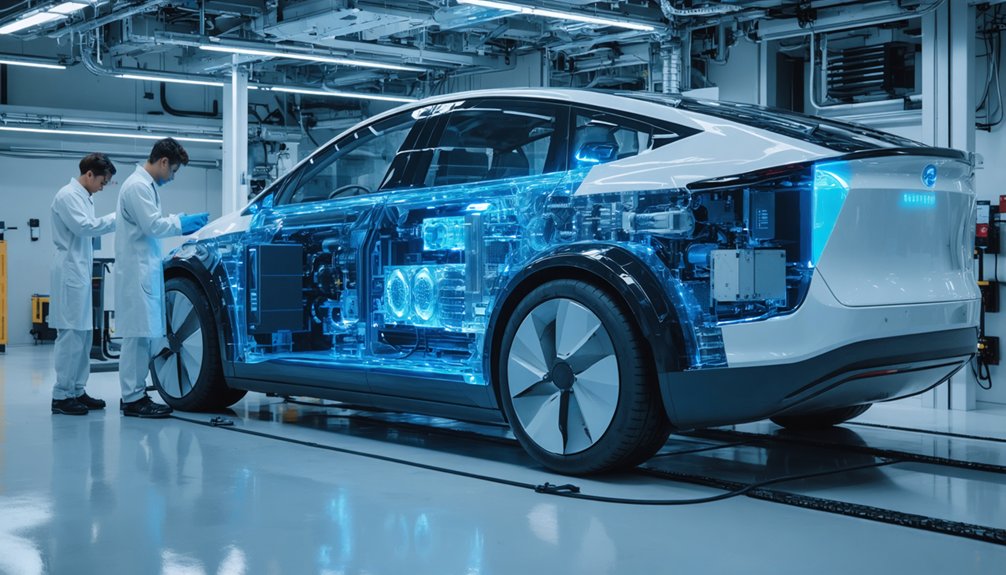
Battery technology is extending EV lifespan through longer-lasting chemistries, smarter battery management, and stronger pack design. Real-world data show average battery degradation near 2.3% per year, with many packs retaining well above 70% capacity after eight to 12 years. LFP, semi-solid, and emerging solid-state and lithium-metal cells improve cycle life and thermal stability. Advanced BMS software also limits stress from heat, voltage, and charging. The details behind these gains become even clearer just ahead.
Highlights
- Improved lithium-ion chemistries and thermal controls now let EV batteries last about 10 years, with newer designs aiming for full vehicle lifespan.
- Real-world data show EV batteries degrade slowly, averaging about 2.3% capacity loss per year and typically staying above warranty thresholds.
- LFP batteries extend lifespan through better heat tolerance, safety, and cycle life than higher-density NMC or NCA chemistries.
- Battery management systems protect packs by balancing cells, controlling charging, monitoring temperature, and detecting faults before serious damage occurs.
- Fast-charging harm is limited in normal use, especially when software and thermal systems prevent charging at extreme temperatures or battery levels.
Why EV Battery Lifespan Is Getting Longer
Although early concerns centered on rapid battery wear, current EV packs are lasting longer because cell chemistry, thermal management, and charging control have all improved at the same time.
Traditional lithium-ion packs already reach about 5,000 cycles, or roughly 10 years, while 2026 chemistries, including semi-solid-state designs, are extending life further toward full vehicle lifespan. Some semi-solid batteries now deliver over 6,000 cycles, showing how semi-solid designs are pushing durability even further.
Field data reinforces that progress. Across more than 8,000 vehicles from 36 manufacturers, used EVs up to 12 years old averaged 95.15% battery health, and eight-year retention sits near 82% on average. Geotab’s broader 2025 analysis found average battery degradation of just 2.3% per year, highlighting slow degradation across real-world EV use. Most used EV batteries also remain well above the industry’s 70% warranty threshold, reinforcing confidence in long-term durability.
Experts also point to stronger thermal regulation and thermalcycling management: newer liquid-cooled systems cut decay by 40% versus 2023 models and hold charging temperatures within ±1°C.
Even under climate stress, newer batteries see only about a 3% lifetime impact overall.
How Smarter BMS Protects EV Batteries
Just as important as better cell chemistry, a smarter battery management system (BMS) is what keeps an EV pack operating inside safe and low-wear limits every second it is in use. It continuously tracks cell voltage, current, temperature, state of charge, and state of health, then balances cells to reduce uneven stress and improve range accuracy. It also communicates with chargers through CAN, UART, or RS485 to support smart charging and prevent overheating during power delivery. Because chargers do not monitor each cell individually, the BMS provides cell-level protection by adjusting or stopping charging when any cell reaches unsafe voltage or temperature limits. Through continuous fault diagnosis, it can identify abnormal conditions early and help maintain pack reliability.
Modern systems also enforce over-current, over-voltage, under-voltage, and temperature protections, disconnecting the pack when faults appear. Active balancing, thermal control, and intelligent SOC recalibration help limit damage from overcharging, deep discharge, and heat.
With AI diagnostics, remote monitoring, and firmware updates, the BMS can flag emerging issues earlier and support safer, more consistent operation. For drivers seeking reliability, that invisible supervision is increasingly what helps the whole EV community trust battery longevity.
Why Better Battery Chemistry Adds Years
Battery management helps protect a pack day to day, but battery chemistry sets the baseline for how slowly that pack ages over years of use. Data-backed aging models show LFP commonly delivers 2,000 to 4,000 cycles, often 10 to 15 years, while NMC typically reaches 1,000 to 2,000 cycles and 8 to 10 years. Standard EV battery warranties of 8 years or 100,000 miles, often with a 70% capacity threshold, reinforce how modern chemistries are expected to retain useful performance over time.
Experts point to thermal chemistry, density trade offs, and thermal management as the main drivers. LFP favors safety, durability, and cost efficiency over peak range, with better tolerance to heat and lower replacement risk. NMC and NCA offer more energy density, but frequent fast charging and extreme heat can accelerate wear. Solid-state designs are expected to push lifespan further with minimal capacity loss over 15 to 20 years. Improved chemistries now hold about 70% capacity after a decade, supporting stronger supply chain resilience, more responsible raw material sourcing, and lower recycling impact across vehicle communities. Battery chemistry also shapes baseline degradation, with aggregated fleet data showing average EV battery fade around 2.3% per year across 21 models.
How Solid-State Batteries Could Extend EV Life
How might solid-state batteries change the lifespan equation for EVs? Evidence suggests they could materially extend usable vehicle life by slowing battery degradation while improving reliability. Designs using a ceramic electrolyte replace flammable liquids, strengthening solid state safety and reducing thermal runaway risk. That stability matters to drivers who want technology they can trust and feel confident adopting together. Compatibility with many existing EV platforms could speed wider adoption without requiring complete vehicle redesigns.
Laboratory and prototype results are notable. Some solid-state systems show degradation only after 5,000 cycles, versus roughly 1,000 for conventional lithium-ion, while production-ready concepts target 100,000 cycles. They also support faster charging, often reaching 80% in 10 to 15 minutes, with less heat generation. Performance remains strong from -30°C to 100°C, retaining over 99% capacity, which could reduce stress across years of real-world use. Some automakers say solid-state batteries could boost EV range by 50% to 80%, reducing the frequency of charge cycles over a vehicle’s lifetime. Early adoption is expected in premium models before mainstream availability expands with lower costs.
How Lithium-Metal Batteries Improve EV Lifespan
Why does lithium‑metal chemistry matter so much for EV longevity? Researchers point to 30–50% higher energy density than conventional lithium‑ion cells, with anode‑free designs replacing graphite with a copper current collector to simplify architecture and reduce loss pathways.
A 15‑nanometer artificial polymer layer, paired with surface engineering, improves electrolyte and interfacial stability for more durable cycling. The coating can be applied through scalable roll‑to‑roll iCVD, supporting low-cost manufacturing for existing battery production lines. The coating also forms a LiF-rich layer that helps block harmful reactions on the lithium surface.
Evidence also shows a poly‑film coating and dual‑passivation strategy can suppress parasitic reactions while supporting smoother lithium transport. In one major pouch-cell demonstration, researchers achieved 600 cycles while retaining 76% of initial capacity.
In testing, coated cells retained 80% capacity after 600 cycles, a commercially meaningful benchmark. Additional electrolyte advances reached 500 Wh/kg and doubled lifespan to 483 cycles by reducing degradation and dead lithium formation.
Together, these gains strengthen confidence that lithium‑metal batteries can help EV owners stay in the transition longer.
Why Fast Charging No Longer Hurts Batteries
Fast charging no longer appears to be the battery-life threat it was once assumed to be. Large real-world datasets support that shift.
Recurrent found no significant capacity gap among 12,500-plus Teslas, even when fast charging dominated.
Geotab likewise reported minimal battery-health differences and average degradation near 2.3% annually.
Researchers still note some added wear at very high charging power, extreme temperatures, or near 5% and 90% charge. Yet modern EVs counter those risks through thermal management, preconditioning, and automatic rate control.
That is why current guidance centers on charging etiquette rather than alarm: reserve frequent DC fast charging for heavy-use days or trips, especially when charging cost matters.
For most drivers, battery warranties and field data indicate only a small long-term penalty, reinforcing confidence across the broader EV community today.
How Pack Design Boosts EV Battery Lifespan
Beyond charging behavior, pack design now plays a central role in extending EV battery life. Newer packs, such as Audi’s Q6 e-tron, use fewer cells, less weight, and fewer rare earths, reducing component stress while improving manufacturing reliability. This light pack modularity lowers failure points and supports faster assembly without sacrificing durability.
Software also strengthens pack longevity. Virtual parallel charging reduces voltage losses and improves charge-cycle control, helping preserve usable capacity over time. Real-world benchmarks reinforce confidence: Tesla reports about 70% capacity after eight years and 100,000 to 150,000 miles, while Hyundai and Kia target under 30% degradation after 10 years and 100,000 miles. Combined with thermal management optimization and climate-tested validation, these design advances support the longer, more dependable battery life EV drivers increasingly expect together.
References
- https://www.woodmac.com/news/opinion/ev-and-battery-supply-chain-2026-outlook/
- https://www.greencars.com/news/a-1-000-mile-ev-battery-is-coming
- https://www.torquenews.com/17995/battery-wheels-revolution-and-why-2026-marks-dawn-58-billion-vehicle-grid-era-and-end-energy
- https://www.youtube.com/watch?v=hFQU5YN9fAA
- https://www.batterybusinessclub.com/the-top-5-battery-industry-trends-driving-innovation-in-2026/
- https://pv-magazine-usa.com/2025/12/31/whats-next-for-battery-technology-in-2026/
- https://www.nextmsc.com/blogs/driving-the-electric-transition-innovation-and-scale-in-2026
- https://interestingengineering.com/ces-2026/top-10-ev-tech-trends
- https://news.umich.edu/improved-ev-battery-technology-will-outmatch-degradation-from-climate-change/
- https://www.uli-power.com/news/2026-ev-battery-tech-trends-fast-charging-long-lifespan-or-lightweight-which-is-worth-waiting-for/

