


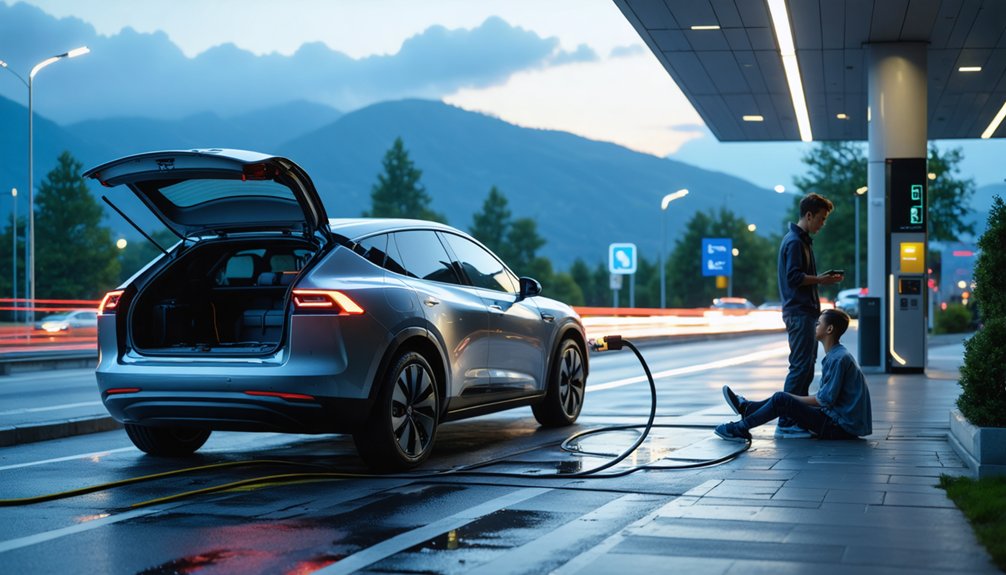
Ultra-fast charging is reshaping EV road trips by shrinking stops to roughly 20–30 minutes for a 20–80% refill, often every 120–160 miles. New 800V EVs such as the Hyundai Ioniq 5, Kia EV6, Porsche Taycan, and Xpeng models can add about 100 miles in well under 10 minutes under ideal conditions. Better highway charger coverage, real-time station data, and growing NACS adoption are making routing simpler, more reliable, and much closer to conventional long-distance travel.
Highlights
- Ultra-fast charging enables 120–160 mile driving legs with 20–30 minute stops every 2–3 hours, making EV road trips feel more like gas-car travel.
- Charging from about 10% to 80% state of charge delivers the fastest refill rates, reducing trip time and helping preserve battery health.
- 800-volt EVs can sustain much higher charging power, often adding about 100 miles in under 10 minutes on capable chargers.
- Better route planning tools now show real-time charger availability, outages, and status, making long-distance EV travel more predictable and reliable.
- Expanding highway fast-charging networks, including NACS and NEVI corridors, are reducing compatibility issues, wait times, and gaps between charging stops.
Why Ultra-Fast Charging Changes EV Road Trips
Because highway travel naturally breaks into rest-stop intervals, ultra-fast charging reshapes EV road trips around short, efficient sessions rather than long refueling delays.
Highway drivers typically pause every two to three hours, covering roughly 120 to 160 miles, then recharge from about 20–30% to 70–80% in 20–30 minutes. That rhythm reduces total travel time because charging remains in the battery’s quickest range, while the final leg can top up more fully for arrival confidence. Driving closer to 65–70 mph also improves efficiency, since moderate highway speeds can meaningfully extend real-world range between charging stops.
Reliable corridor networks also strengthen belonging by making routes feel connected rather than uncertain, supporting anxiety reduction and calmer trip planning. Many EVs also limit fast charge above about 80% state of charge, which makes shorter road-trip sessions more efficient than charging to full at every stop. Stopping around 80% also supports battery longevity by avoiding the slowest, most stressful part of the charging curve.
Verified routing apps help confirm charger status, spacing, and compatibility.
Evidence on battery longevity is reassuring: large-scale Tesla data found no statistically significant range-loss difference tied to heavier fast-charging use in road-trip conditions.
How Fast Can Today’s EVs Charge?
That road-trip rhythm depends on a simple question: how quickly an EV can actually recover useful range at a high-power charger. In today’s market, the fastest results come from 800V systems and strong battery management, not just headline peak numbers. BYD’s Han L pushes the frontier further with 1,000 kW flash-charging capability, though for now it remains limited to China.
Hyundai’s IONIQ 5 can add 100 miles in 5.79 minutes, while the IONIQ 6 does it in 7.43 and the Kia EV6 in 8.55. Porsche Taycan and Audi e-tron GT reach 10 to 80 percent in 18 minutes, and Xpeng’s latest models do so in roughly 13 to 15. Real-world peaks now stretch from about 320 to 453 kW, with Lotus Emeya reaching 443 kW. As charging speeds rise, real-time availability data in vehicle navigation is becoming just as important for keeping road-trip stops short and predictable. Temperature, charger capability, and pack conditioning still shape impact charging, especially for 400V EVs, which often need 30 minutes or more to reach 80 percent. Because charge curves often matter more than a vehicle’s advertised peak rate, real-world road-trip charging is best judged by how quickly an EV adds usable miles across its session.
Which EVs Add 100 Miles Quickest?
Which EVs recover 100 miles the quickest depends less on badge and more on charging curve, voltage design, and charger availability.
In current testing, Xpeng G9, Lotus Eletre, Porsche Taycan, and Hyundai‑Kia E‑GMP models rank among the quickest, often restoring roughly 100 miles in well under 20 minutes on suitably powerful DC chargers.
Real‑world leaders pair strong Battery tech with efficient Charging framework. 800-V architecture is a major reason models like the Ioniq 5, Ioniq 6, and EV6 can sustain very high charging power on 250–350 kW stations.
The Xpeng G9 posts about 13 minutes from 10 to 80 percent, while the Lotus Eletre and Taycan follow closely. Its 453 kW peak helps explain why it currently sets the pace in Europe.
Hyundai Ioniq 5, Ioniq 6, and Kia EV6 remain standout mainstream choices because they sustain high power reliably.
Tesla Model 3 Highland also performs strongly, though usually behind the fastest peak‑rate rivals.
For many drivers, charger access still determines whether those headline gains translate into road‑trip confidence and community reassurance.
Why 800V EV Charging Is a Big Deal
Step up from a typical 400V design to an 800V system, and the charging equation changes materially: by operating at roughly 550V to 950V instead of the more common 230V to 450V range, these EVs can deliver far more power with less current, less heat, and lower resistive loss. Because resistive heating scales with current squared, I²R losses can drop by about 75% when current is halved for the same power. 400V chargers are still more widely available across existing infrastructure, which remains an important practical advantage for many drivers today.
That matters on the road: 800V Battery designer can support up to 350 kW, cut charging time by about half, add roughly 200 km in 10 minutes, and move from 5% to 80% in about 22.5 minutes on a 270 kW charger. Lower current also means thinner wiring, less copper, lower weight, better thermal efficiency, and reduced battery stress. Automakers such as Porsche, Hyundai, and Audi lead adoption, though Infrastructure cost and higher component prices remain meaningful barriers today. Most existing public chargers were built around 400V infrastructure, which helps explain why charging-network upgrades remain a key challenge for broader 800V adoption.
How Charging Networks Are Improving Road Trips
Expanding charging networks are making EV road trips materially easier by increasing both coverage and charging speed along major travel routes. Public fast-charger installations rose nearly 33% in 2025, signaling rapid expansion even as the broader EV market remained cautious.
In 2024, the United States reached 73,000 active charging stations, while public DC fast-charging ports topped 70,000 and kept growing in 2025. Automakers are also integrating charger status into in-car navigation, improving station availability visibility for drivers on the road.
NEVI funding is helping build reliable highway corridors with chargers about every 50 miles, while setting standards for uptime, payment access, and high-speed service. The program also reduces investment risk and improves rollout confidence through federal funding.
That broader buildout supports infrastructure equity by extending access into rural and lower-income communities, helping more drivers feel included in long-distance EV travel.
Network use also shows rising confidence: ChargePoint alone enabled 19 billion electric miles, with sessions up 34% in 2025.
Even so, higher utilization underscores the need for reliability upgrades, fleet-ready capacity, and stronger power‑grid integration planning nationwide.
What NACS Means for EV Road Trips
For road trips, North American Charging Standard (NACS), now designated SAE J3400, matters because it turns a fragmented charging experience into a more unified one.
Maintained by SAE International, the standard uses one compact connector for AC and DC charging, making ports easier to handle and simpler for automakers to package. This single connector design also uses shared pins for both AC and DC charging, helping keep the plug compact while supporting seamless mode switching.
Its significance grows with access. Tesla’s network leads North America in fast‑charging ports, and NACS compatibility increasingly opens those stations to more drivers through native ports, Magic Dock sites, and improving adapter availability.
Major automakers are shifting to NACS for 2025 models, while Electrify America, ChargePoint, and EVgo are adding NACS alongside CCS.
For travelers, that means broader network access, fewer connector worries, and a stronger sense that the charging ecosystem is finally aligning around one shared, dependable path.
How to Plan Faster EV Charging Stops
With charging standards becoming more unified, the next gain on a road trip comes from planning stops around speed, reliability, and real-time information.
Automaker guidance now shows live charger availability, uptime, and outages before arrival, helping drivers choose dependable sites and improve route optimization.
Networks increasingly build multi-charger stations, reducing waits and making shorter 20‑minute sessions more realistic.
Planning also favors locations on Alternative Fuel Corridors and highway hubs with food, shelter, and accessible spaces, creating a more predictable experience for every traveler.
In rural areas, chargers near gas stations or diners can keep detours minimal.
Real‑time public data requirements in places like Hawaii, plus testing and uptime rules in California and Kansas, support smarter choices.
Shorter, well‑timed stops can also support battery health during long drives.
References
- https://www.recurrentauto.com/research/fastest-charging-evs
- https://www.greencars.com/news/ev-charging-in-2026-is-about-to-change-in-three-important-ways
- https://powy.energy/en/news/evolution-news/auto-ricarica-piu-veloce-2026/
- https://evchargingstations.com/chargingnews/largest-dc-fast-charging-networks-jan-2026/
- https://www.versinetic.com/news-blog/ev-charging-infrastructure-2026-trends/
- https://www.ezevelectric.com/ev-charging-industry-predictions-and-trends-2026/
- https://jinyuautos.com/blog/fastest-charging-evs-of-2025-2026/
- https://tridenstechnology.com/ev-charging-industry-trends/
- https://recharged.com/articles/how-to-maximize-ev-range-on-road-trip
- https://www.recurrentauto.com/research/impacts-of-fast-charging

