


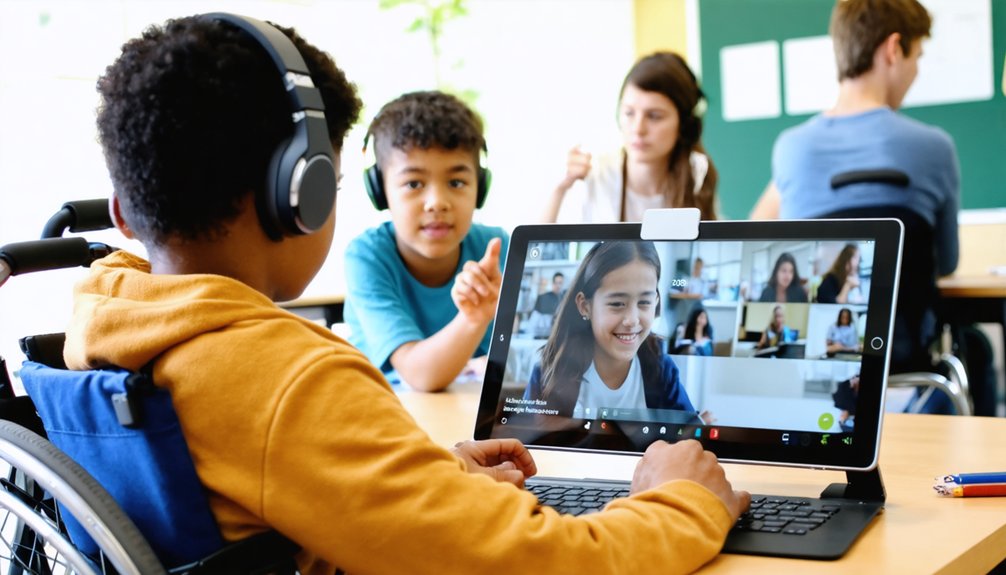
Hybrid learning expands accessibility by combining face-to-face teaching with online access, so students can participate despite distance, work, health, or family constraints. It supports students with disabilities through captions, voice control, repeatable lessons, and flexible pacing across devices. Evidence also links blended formats to stronger engagement, retention, and persistence than fully online or traditional models. Its benefits are greatest when schools provide reliable internet, accessible platforms, and offline options. The key conditions and impacts are outlined below.
Highlights
- Hybrid learning lets students join in person or online, reducing barriers from distance, disability, transportation, health, and work schedules.
- Recorded lessons, self-paced modules, and 24/7 access help learners review content repeatedly and study when time allows.
- Accessibility tools like captions, screen-reader support, voice control, and mobile access make learning usable across diverse needs and devices.
- Hybrid models expand equity by lowering relocation, housing, and commuting costs for rural, part-time, and underrepresented students.
- Accessibility grows most when schools provide reliable devices, internet, offline materials, and WCAG-compliant platforms with ongoing support.
What Makes Hybrid Learning More Accessible?
Why is hybrid learning often considered more accessible? Evidence points to broader participation, stronger accommodation, and lower costs.
Online components extend learning beyond campus, supporting global equity by reaching students wherever internet access exists; USC’s HyFlex standard illustrates this reach, and 76% of international students prefer some lectures online. Hybrid programs also expand access for distant learners by reducing the need for permanent relocation while preserving campus experiences. More broadly, over 80% of students want at least some courses or meetings online, reflecting strong demand for flexible learning.
Hybrid design also advances digital inclusion through captions, voice control, mobile tools, and flexible materials that serve visual, auditory, and kinesthetic learners. Universal Design for Learning strengthens this approach by promoting inclusive access for all learners.
Accessibility also improves for students with disabilities and other underrepresented groups. Fifty-seven percent of students use at least one assistive technology, and students with special needs report learning more efficiently and feeling safer online.
Structured hybrid models have also produced higher exam scores for Hispanic and Black students while reducing housing, transportation, relocation, and materials costs overall.
How Hybrid Learning Removes Time Barriers
Accessibility in hybrid learning extends beyond who can participate to when learning can happen. By reducing time barriers, hybrid models let students access materials around the clock, complete assignments when schedules allow, and combine online study with fewer in-person requirements. This flexibility helps learners balance coursework with jobs, family responsibilities, and extracurricular commitments without losing connection to their academic community. Research in hybrid models shows lower turnover through greater flexibility, highlighting how reduced scheduling pressure can help participants stay engaged over time.
Evidence suggests that self-paced hybrid formats improve outcomes while easing rigid scheduling pressures. Personalized pacing has been linked to a 62% increase in comprehension and a 17% increase in retention, while freeing 40–60% of classroom time for independent learning. Around-the-clock access also increases motivation by 59%. Importantly, hybrid programs report a 95% re-enrollment rate, compared with 81% in fully online settings, indicating stronger sustained participation over time.
How Hybrid Learning Supports Students With Disabilities
Across hybrid learning environments, support for students with disabilities is strengthened by flexible participation, accessible technology, and course structures that reduce common barriers to engagement.
Students can attend in person or remotely, which helps those with mobility, transportation, or health‑related limitations remain connected to coursework and community.
HyFlex standards, closed captioning, voice control, and Assistive tech improve access across devices and platforms.
Research also indicates that structured hybrid courses support stronger outcomes for underrepresented learners, including students with disabilities. Emerging evidence from mixed-methods research is helping define which hybrid practices most effectively improve engagement and outcomes across diverse student needs.
Online components enable assisted pacing through repeatable lessons, accessible navigation, and self‑directed review, which can support cognitive processing needs.
High‑quality accessibility tools positively affect learning for 92% of students, while teachers also report improved academic ability.
In this model, access is embedded more consistently into everyday participation.
Why Hybrid Learning Reaches More Learning Styles
Blending online and in-person instruction allows hybrid learning to support a wider range of learning styles through flexibility, multimedia content, and adjustable pacing.
Online modules can present diagrams, video, captions, and text together, making multimedia personalization practical for visual and reflective learners.
In-person sessions then add discussion, demonstration, and auditory‑kinesthetic integration, helping students connect concepts in ways that feel natural and inclusive.
Evidence suggests this flexibility matters.
Eighty percent of students prefer at least some online coursework, and 82% globally want online components to remain.
Hybrid structures also let learners move at a pace that fits their needs, while highly structured designs raise exam scores across student groups and reduce achievement gaps.
With access from any internet-connected location, more learners can participate in ways aligned with how they learn best.
How Hybrid Learning Boosts Engagement and Retention
Why do hybrid models often keep students more involved and help them remember more? Evidence points to a strong mix of teacher support, flexible pacing, and meaningful interaction.
In blended settings, subject-level guidance is the strongest driver of engagement, while interactive recordings, discussions, and LMS activities strengthen persistence. Student preference also supports this pattern, with 70% saying they learn best in blended classrooms. A SEM-PLS study of 140 higher education students found that hybrid educational models significantly increased student engagement, underscoring the value of hybrid engagement.
Face-to-face sessions also raise performance and skill engagement, with higher participation linked to stronger emotional connection and belonging.
Retention outcomes are also notable. Blended learning commonly delivers 25-60% retention, compared with about 10% in traditional classrooms, and can reduce learning time by 40-60%. Blending online and face-to-face instruction often produces better outcomes than either method alone, highlighting the value of combined delivery.
Teacher motivation further reinforces these gains: 73% of teachers report higher engagement, and 59% of students report greater motivation.
Meanwhile, data analytics from LMS platforms help educators personalize support, improving participation, completion, and long-term understanding.
Where Hybrid Learning Helps Equity the Most
These gains matter most when viewed through an equity lens, because hybrid learning often expands access for students who face the steepest barriers in traditional formats. Evidence shows Hispanic and Black students perform better in highly structured hybrid courses than in low-structured face-to-face settings, with stronger engagement linked to lower dropout risk. Hybrid learning is especially valuable for flexible attendance among part-time students, interns, and financially constrained learners.
Benefits are also clear for learners outside conventional campus reach. Rural outreach improves options for remote students, while online components support those managing distance, work, or disrupted attendance. Students with disabilities gain more customized pathways through combined digital and in-person participation. For low-income learners, income flexibility matters when fixed-location costs limit enrollment or persistence. In career and technical pathways, hybrid models also widen certificate access for working adults and geographically isolated students seeking opportunity. Still, concerns about educational inequality remain, with 44% of parents believing hybrid learning can deepen inequities.
What Schools Need for Accessible Hybrid Learning?
Accessible hybrid learning depends on four core conditions: reliable technology, legal compliance, inclusive course design, and sustained support.
Schools need high-speed internet, Device provisioning, and platforms vetted for WCAG 2.1 Level AA, with screen reader compatibility and flexible, low-data access through Bandwidth optimization. They should also provide printed materials and thumb-drive options for students facing connectivity barriers to ensure offline access.
They also need clear compliance planning. Public institutions face Title II ADA deadlines by April 24, 2026, while private institutions remain responsible under Title III and Section 504 for equal access to online programs. Institutions receiving federal funds must also meet annual compliance reports requirements for digital accessibility. WCET offers expert support through resources, insights, and community guidance to help institutions prepare for compliance.
Effective models build Universal Design for Learning into lessons from the start, include subtitles and adjustable text, and use culturally responsive materials.
Faculty benefit from instructional design partners, developers need testing tools, families need guidance at home, and institutions need ongoing audits, vendor vetting, and feedback systems to improve access continuously.
References
- https://www.livewebinar.com/blog/education/2021-hybrid-learning-statistics-in-a-nutshell
- https://pmc.ncbi.nlm.nih.gov/articles/PMC11241882/
- https://campustechnology.com/articles/2021/09/09/survey-accessibility-challenges-persist-as-hybrid-and-online-learning-continues.aspx
- https://oidigitalinstitute.com/news/how-hybrid-and-online-learning-supports-student-accessibility-and-affordability/
- https://er.educause.edu/articles/2023/2/hybrid-learning-and-space-reimagination-optimizing-access-and-equity-to-promote-student-success
- https://dl.acm.org/doi/full/10.1145/3711670.3764652
- https://files.eric.ed.gov/fulltext/EJ1410414.pdf
- https://www.nea.org/professional-excellence/student-engagement/tools-tips/overview-hybrid-learning-models
- https://teachonline.ca/tools-trends/articles/navigating-challenges-hybrid-learning/
- https://www.tandfonline.com/doi/full/10.1080/02680513.2025.2512464

