


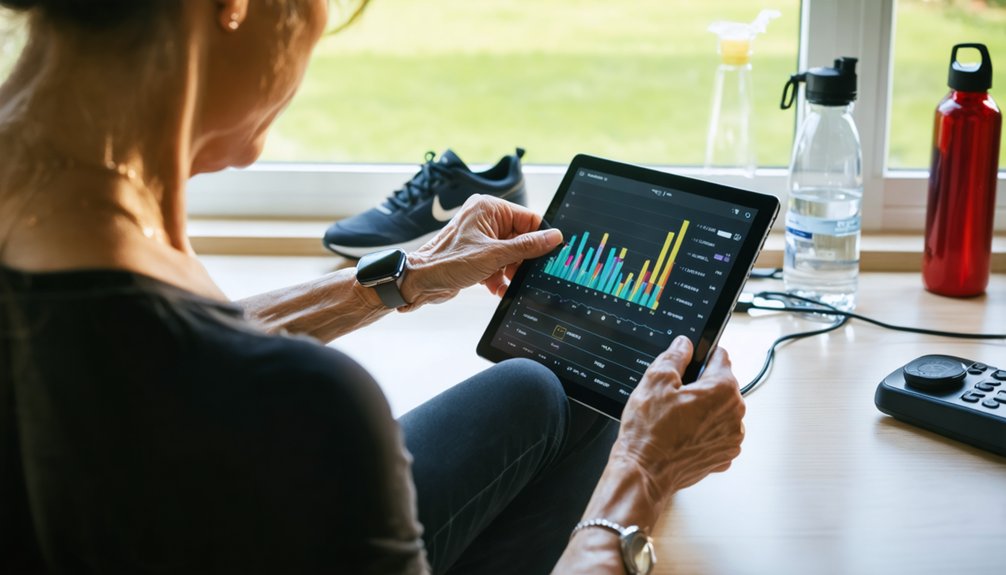
Wearables track long-term health trends by continuously recording metrics like resting heart rate, HRV, sleep, blood oxygen, respiratory rate, steps, and activity intensity. Their software compares daily data against a personal baseline to spot meaningful changes over weeks or months, helping identify patterns linked to arrhythmias, infection, inactivity, or rising cardiometabolic risk. Accuracy is strongest at rest and during sleep, while exercise data can vary. The sections ahead explain which metrics matter most and where limits remain.
Highlights
- Wearables continuously record metrics like resting heart rate, HRV, sleep, SpO₂, steps, and activity to build personal long-term health baselines.
- By comparing new data against baseline patterns, wearables can flag meaningful changes linked to arrhythmias, infections, diabetes risk, or declining fitness.
- Heart rate and sleep trends are generally reliable at rest, while exercise, battery gaps, and sensor quality can reduce accuracy.
- Long-term tracking works best when users focus on trends over weeks or months instead of reacting to single readings.
- Wearables support proactive health management, but estimates like calories and steps vary by device and can sometimes cause false alarms.
What Wearables Measure Over Time
Wearables capture a broad set of health signals over time, allowing long-term patterns to be observed in everyday settings rather than only during clinic visits. Devices measure resting and exercise heart rate, heart rate variability, sleep quality, blood oxygen saturation, and, in advanced models, blood pressure using optical, biosensor, and electrocardiogram methods.
They also quantify steps, activity intensity, sedentary time, posture, recovery, stress, UV exposure, and electrolytes. Continuous real-world monitoring supports data metrics integration across months, helping individuals feel more connected to their routines and care communities. Evidence shows activity trackers can add about 1,300 daily steps and nearly an hour of weekly moderate-to-vigorous activity. Reaching about 8,800 steps per day is associated with the greatest reduction in cardiovascular disease risk. Devices such as WHOOP use strain scores from heart-rate data to help users balance exertion and recovery over time. Sleep and oxygen measures show meaningful links with clinical outcomes, while privacy compliance remains essential for trusted, inclusive use across diverse populations and settings.
How Wearables Spot Health Trends Early
How do subtle changes become visible before symptoms are noticeable? Wearables make them easier to detect by continuously collecting real-world signals, including heart rate variability, oxygen saturation, movement, respiratory patterns, and blood pressure trends.
Noninvasive biosensors build personal baselines, allowing algorithms to identify small departures that may otherwise go unseen. Through machine learning and data-driven analytics, devices can flag arrhythmias, infection-related changes, fall risk, or rising diabetes risk earlier than occasional exams. This continuous monitoring supports a find, track, treat approach that helps clinicians respond before conditions worsen. By enabling early intervention, wearables help reduce the progression of potential health problems and improve outcomes.
Reported performance includes atrial fibrillation detection in 87 out of 100 cases and COVID-19 detection at 88% accuracy. A large systematic review of 28 studies and more than 1.2 million participants found consumer wearables show promising real-world detection of several medical conditions. These early signals support timely check-ups, medication adjustments, and preventive action.
For many people, that creates a more connected care experience, provided data privacy protections remain clear, trusted, and consistently maintained across systems.
Which Wearable Metrics Matter Most
The next question is which metrics provide the clearest illustration of long-term health. Evidence suggests activity measures remain foundational: 59% of US wearable users track daily steps, while 42% monitor workouts. These patterns help people stay aligned with cardiovascular guidelines, support weight management, and reinforce shared achievement through daily goals. Nearly one in three U.S. adults now uses a wearable device, showing broad adoption of these tools.
Beyond activity, resting heart rate offers a simple indicator of cardiovascular efficiency, and heart-rate variability adds understanding into recovery and resilience. Higher HRV usually reflects better resilience and can be most useful when tracked as a personal trend over time. Sleep duration and quality also provide a long-term baseline for recovery, cognition, and emotional stability. Blood-oxygen saturation and respiratory rate can signal changes during stress or illness, though VO2 max estimates may be overstated. Body-composition measures, including body fat, muscle mass, and water weight, provide a fuller view than scale weight alone. For communities comparing progress, data privacy and privacy adherence remain essential for lasting trust and participation.
How Wearables Track Heart and Sleep Changes
Across long timeframes, heart and sleep trends are captured by combining sensor design with signal processing.
Wrist wearables use PPG light sensors to estimate pulse from blood volume changes, while ECG patches, single‑lead devices, and chest straps record electrical signals for finer hol rhythm analysis. In a pediatric validation study against 24‑hour Holter ECG, both a PPG wristband and an ECG smart shirt achieved about 85% accuracy within ±10% of reference heart rate.
At rest and during sleep, wrist measures generally align well with ECG, with stronger performance under low movement and lower heart rates. However, during exercise and especially in people with atrial fibrillation, wearable heart rate readings can show larger discrepancies compared with ECG.
Algorithms convert PPG into minute‑level records and can identify atrial fibrillation with high accuracy, while on‑demand ECG features improve sensitivity and specificity. In validation studies, smartwatches have been shown to be non-inferior to medical-grade devices for atrial fibrillation detection.
Over nights and weeks, high adherence and reliable data transmission support continuous tracking.
These patterns help users feel part of a health‑aware community by showing shared, understandable changes in resting heart rate, nocturnal trends, and sleep staging over time.
What Wearable Data Can Miss
Even when wearables capture long-term heart and sleep patterns well, their records still have important blind spots. Sensor quality, collection methods, and battery interruptions can distort trends, especially during intense activity. Step counts, heart rate, calorie burn, and energy use often remain estimates, with sizable error across brands. Missing backdrop also weakens prediction: stress, illness, hormones, medications, and daily routines can change readings without clear explanation. Wearables also tend to produce weaker long-term results without personalized guidance.
These limits matter because overprediction can misdirect care and raise unnecessary worry. False positives may be tolerable in fitness, but become riskier in medical screening. Wearables should be used as supplemental information, not as a replacement for professional exams or regular medical checkups. Wearables also cannot track blood nutrients, plaque buildup, or provide full metabolic assessment. Privacy equity concerns and data bias further reduce trust when sensitive information is misused or some bodies and conditions are poorly represented. Frequent alerts and rigid goals can also trigger health-data anxiety, especially when users interpret normal variation as a sign of illness.
Who Uses Wearables Most and Least
Although wearable use spans many groups, adoption is concentrated among younger adults and remains lower among older users.
Adults ages 25 to 34 show the strongest uptake, with penetration above 40%, followed by ages 18 to 24 and 35 to 44 at roughly 30% to 35%.
Usage falls among older s demographics: 45 to 54 report 22.66% using wearables several times weekly, while those over 55 reach 20.34%.
Gender and region also shape usage gaps. Men account for 55% of adoption versus 45% for women, though female participation is rising as devices fit wellness routines. Country ownership data also shows India leads globally, with 57% ownership in 2024, compared with 33% in Brazil.
In the United States, millennials lead with 27.6 million users projected for 2024, while baby boomers remain near 9.4 million.
Globally, 29% of consumers own a wearable, with Brazil lagging and North America leading.
How to Use Wearables for Better Health
How can wearables improve health in practice? Evidence suggests benefit is greatest when people choose validated wrist devices, then track steps, heart rate, and sleep consistently.
Smartwatches dominate use because they combine monitoring, prompts, and a behavior app, helping routines feel shared and manageable. Daily feedback can raise activity, support weight and blood pressure control, and identify issues such as irregular rhythms or poor sleep.
Better results also depend on interpretation and continuity. Trends over weeks or months are more useful than single readings, especially for user motivation and clinical follow-up. Data sharing with healthcare teams can strengthen decisions, improve adherence, and support earlier detection.
To improve device longevity, users benefit from realistic goals, privacy safeguards, and affordable features that match needs, including stress or mental health tracking.
References
- https://www.nhlbi.nih.gov/news/2023/study-reveals-wearable-device-trends-among-us-adults
- https://newsroom.heart.org/news/study-finds-people-who-need-wearable-health-devices-the-most-use-them-the-least
- https://www.jmir.org/2025/1/e56251/
- https://www.ncbiotech.org/sites/default/files/2025-01/NCBiotech_FitnessTrackers_SampleReport2024.pdf
- https://news.cuanschutz.edu/medicine/wearable-fitness-tracker-health-data
- https://pmc.ncbi.nlm.nih.gov/articles/PMC12063813/
- https://runrepeat.com/fitness-tracker-statistics
- https://www.pewresearch.org/short-reads/2020/01/09/about-one-in-five-americans-use-a-smart-watch-or-fitness-tracker/
- https://www.health.harvard.edu/heart-health/do-fitness-trackers-really-help-people-move-more
- https://pmc.ncbi.nlm.nih.gov/articles/PMC11560992/

