


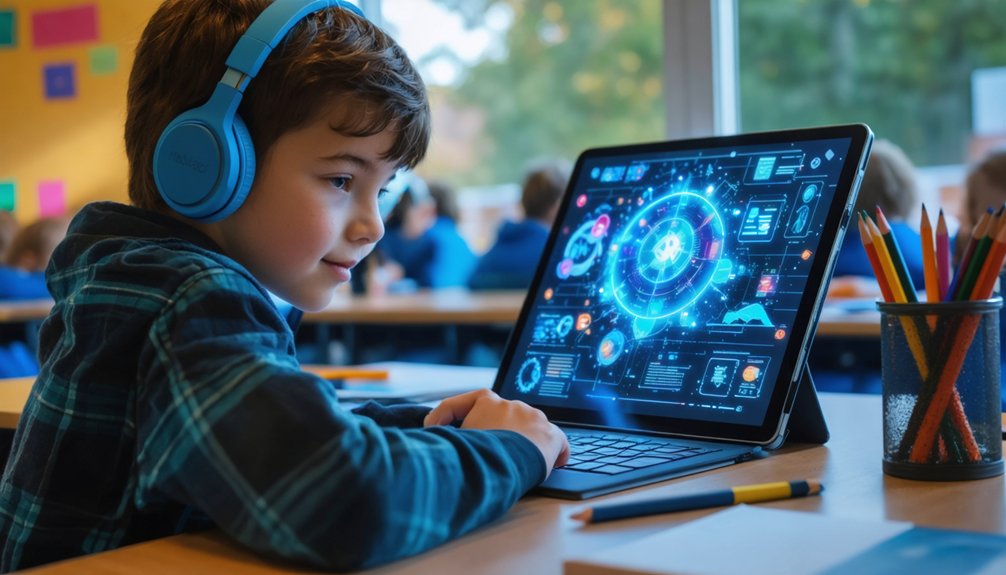
AI tutors personalize learning by tracking each student’s answers, pace, errors, and engagement, then adjusting difficulty, hints, examples, and timing within seconds. They identify learning gaps early, recommend targeted resources, and give instant feedback across writing, math, coding, and test practice. Their always-available, multilingual, and accessible support can raise confidence and participation, while teacher oversight adds context and control. Research shows stronger engagement and measurable score gains, with more practical guidance ahead.
Highlights
- AI tutors analyze student responses, pace, and errors in real time to adjust lesson difficulty, timing, and explanation style instantly.
- They build ongoing student profiles that track strengths, weaknesses, and progress, enabling personalized learning paths and targeted resource recommendations.
- Adaptive scaffolding provides hints, alternative examples, and step-by-step support without judgment, helping students close learning gaps faster.
- Instant feedback on writing, math, coding, and quizzes helps students correct mistakes immediately and stay engaged during practice.
- Continuous availability, multilingual support, and accessible tools like speech-to-text expand personalized learning beyond classroom hours.
What Makes AI Tutors Feel Personal?
Their sense of presence also comes from accessibility and inclusion.
Available around the clock, AI tutors support students across schedules, locations, and learning barriers. AI translation tools also expand access for multilingual learners through multiple languages.
Features such as speech-to-text, text-to-speech, and immediate performance perceptions make participation easier and more confident. Some systems also provide real-time feedback that helps educators notice hesitation, frustration, or loss of focus before disengagement grows. AI tutors can also create personalized learning paths by identifying each student’s strengths and areas for improvement.
When systems communicate with an empathetic tone, they can encourage trust and emotional bonding, giving learners a stronger sense that support is present, reliable, and welcoming during challenging study moments.
How AI Tutors Adapt to Each Student
That sense of individualized support comes from the way AI tutors continuously adjust instruction to match each learner’s performance in real time. Algorithms track responses, pace, and engagement, then refine lesson difficulty, timing, and explanation style within seconds. This creates data‑driven pathways that reflect how students actually learn, rather than forcing everyone through the same sequence. This personalization is powered by a student model that tracks progress, strengths, and areas for improvement over time. Learners also receive targeted resource recommendations based on detected gaps, creating customized learning routes.
When learners advance quickly, AI tutors increase complexity and move ahead. When learners need more time, systems slow pacing, offer alternative examples, and supply adaptive scaffolding that supports progress without judgment. Immediate feedback, targeted hints, and fresh practice help students stay oriented and capable. AI can also summarize patterns for human tutors, who use those observations to provide timely encouragement and guidance. Together, these adjustments help more students feel seen, supported, and able to succeed. In some systems, AI-generated hints have performed about as well as expert-written ones, showing the promise of rapid hint generation.
Where AI Tutors Spot Learning Gaps
Spotting learning gaps begins with continuous analysis of how a student works, not just whether an answer is right or wrong. AI systems examine response patterns, completion time, error types, clicks, pauses, and confidence levels to improve gap detection within minutes. Real-time performance analysis enables quick identification of knowledge gaps so support can begin sooner.
Natural language processing also reviews written explanations, helping identify misunderstandings beyond multiple-choice items. Studies show NLP scoring can reach a 92% correlation with expert evaluations when assessing student comprehension.
Predictive modeling extends that analysis by estimating where difficulties will appear next, using prerequisite knowledge, engagement, and academic history. Systems can flag fraction weaknesses before percentages become a problem and map subjects into precise knowledge points for closer diagnosis. Proactive outreach based on these predictions can support disengaged learners before they fall further behind, helping institutions avoid the Five Percent Problem.
In classrooms, this creates a clearer image of shared needs as well as individual struggles. At Lincoln Elementary, gaps were identified within 24 hours, shortening closure time from 6–8 weeks to 3–5 days markedly.
How AI Tutors Give Instant Feedback
Once learning gaps are identified, AI tutors respond by providing feedback at the point of learning, when students are most prepared to use it. Using NLP and machine learning, these systems analyze answers against rubrics, standards, and answer keys, then return customized guidance within moments. Teachers remain essential by reviewing AI suggestions and adding human context, ensuring teacher control stays central to instructional decisions. In some peer review tools, students can also receive live suggestions that update as they revise their feedback, helping them make comments more specific, respectful, and useful.
This immediate response helps learners correct errors before misconceptions settle, focus attention on specific revisions, and strengthen memory through manageable prompts. Multi-format processing supports essays, coding, math, tests, and peer review, while adaptive updates refresh suggestions as work changes. Platforms such as Gradescope, Century Tech, and Class Companion show how feedback time analytics can reveal patterns in struggle and progress. Class Companion also provides instant feedback, scores, and AI tutor support so students can revise while the learning moment is still fresh. In turn, adaptive scaffolding adjusts next steps to individual needs, offering structured support that helps each student feel seen, supported, and included in the learning process.
Why AI Tutors Boost Engagement and Scores
Three factors help explain why AI tutors often raise both engagement and academic performance: personalization, continuous availability, and responsive support. Studies show customized instruction improves outcomes by addressing the one-size-fits-all limits of traditional classrooms. With unrestricted access, students have posted test gains of 0.23 standard deviations and scores 0.34 standard deviations above control groups, indicating that engaged personalization and availability work together. AI tutors are especially effective for structured practice such as drilling factual knowledge, rapid feedback, and narrowly constrained academic tasks.
Engagement also rises because learners can get help when they need it, especially during evening study hours. Students report stronger motivation, deeper participation, and lasting confidence; 44 percent said problem‑solving confidence increased. Research also finds AI tutoring platforms can improve behavioral, emotional, and cognitive student engagement through adaptive feedback, personalized content, and real-time monitoring. In one flipped Physical Sciences 2 course, students using an AI tutor bot showed significantly higher engagement gains than those in a traditional classroom. AI tutors also support knowledge transfer across subjects, helping students practice until skills stick.
For communities considering adoption, these benefits are strongest when systems are designed with clear data privacy protections in place.
How Teachers Use AI Tutors in Class
Those gains depend not only on what AI tutors can do for students, but also on how teachers use them in daily instruction.
During 2024-2025, 60% of U.S. public school teachers used AI tools, most often for lesson preparation, grading, assessments, and parent communication.
Weekly users saved 5.9 hours, helping relieve administrative strain and creating more time for mentoring.
Use remains uneven. High school teachers adopt AI more often, while only 19% work in schools with formal guidance and 68% receive no teacher training.
In practice, teachers often pair AI tutors with platforms such as Google Classroom, i-Ready, or Khan Academy to adjust materials and support personalized instruction.
Effective classroom use also depends on policy workshop access, policy compliance, and data privacy safeguards, especially because concerns about accuracy and student dependence remain.
What to Look for in an AI Tutor
What should schools and families examine first when comparing AI tutors? Strong options provide broad subject coverage across math, science, English, and history, with support from middle school through college. They align lessons to curriculum standards, assist with homework and test preparation, and fit full academic schedules rather than one class.
Buyers should also review personalization, accuracy, privacy, and pricing. Effective systems assess current knowledge, remember past questions, adapt pacing, and offer adjustable difficulty for visual, verbal, or kinesthetic learners. Credible vendors explain guardrails against errors, bias audits, encryption, and high-information feedback. Integration matters too: the tutor should work within LMS, email, or intranet tools and match institutional standards. Evidence of learning gains, independent reviews, and research helps families and schools choose with confidence together.
References
- https://www.facultyfocus.com/articles/teaching-with-technology-articles/designing-the-2026-classroom-emerging-learning-trends-in-an-ai-powered-education-system/
- https://www.insightaceanalytic.com/report/ai-in-personalized-learning-and-education-technology-market/2692
- https://www.wise.live/blog/top-ai-tutor-trends/
- https://tutorbase.com/statistics/edtech-ai
- https://brighterly.com/blog/ai-in-education-statistics/
- https://programs.com/resources/ai-education-statistics/
- https://virtualspeech.com/blog/ai-training-statistics
- https://tutorflow.io/blog/how-ai-is-transforming-education-2026
- https://www.researchandmarkets.com/reports/6226612/ai-personal-tutors-market-report
- https://edtechmagazine.com/k12/article/2026/03/ai-tools-support-personalized-learning-k-12-education?amp

