

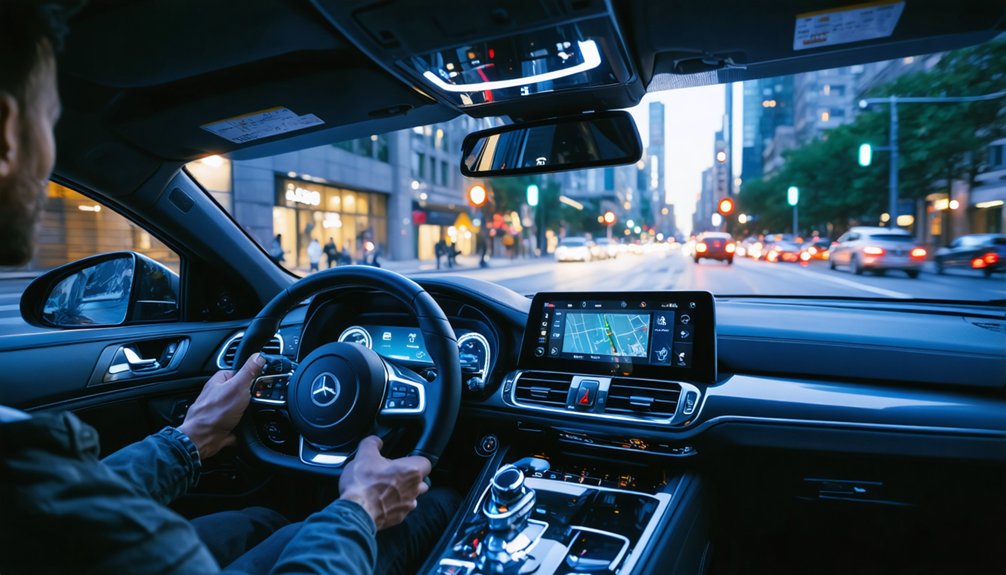

Connected cars enhance driver experience through real-time safety alerts, personalized settings, smarter routing, and proactive maintenance. AI uses driver behavior, smartphone data, and vehicle telemetry to tailor infotainment, comfort, and service alerts. Sensor fusion and V2X communication can extend road awareness and help prevent collisions, while predictive diagnostics catch issues early. They also simplify tolling, charging, and trip tracking. Adoption still faces cost, privacy, and coverage concerns, but the broader impact becomes clearer ahead.
Highlights
- Connected cars personalize infotainment, navigation, and cabin settings using driver data, smartphone syncing, and AI-built profiles.
- Real-time traffic, smart routing, and hands-free tolling make trips smoother, faster, and less stressful.
- Voice assistants and adaptive controls reduce manual tasks by handling calls, directions, media, and vehicle settings.
- Sensor fusion, V2X communication, and connected ADAS improve safety with predictive hazard alerts and faster driver response.
- Predictive maintenance uses live vehicle diagnostics to spot issues early, reduce breakdowns, and schedule service proactively.
What Makes a Connected Car Feel Smarter?
Smarter also means more personal. Data-backed personalization adapts infotainment, smartphone integration, and subscription features to what drivers value most, with 67% willing to pay more for better capabilities. Many drivers still miss out because 40% unaware they even have connected services available in their vehicle.
Edge integration supports faster in-vehicle responses, while predictive analytics uses continuous diagnostics to refine mileage, battery health, and software performance. With 237M connected cars already in operation globally in 2021, these capabilities are quickly becoming a standard part of everyday driving. Drivers also expect privacy safeguards, with most preferring opt-in collection when personal data is involved.
In a market moving toward USD 26.5 billion by 2030, connected intelligence increasingly defines what drivers expect and trust.
How Connected Cars Make Driving Safer
As connectivity extends beyond convenience, it becomes a critical safety layer that helps vehicles detect, interpret, and respond to risk faster than driver awareness alone.
Through sensor fusion, connected cars combine onboard inputs with V2X messages from nearby vehicles and infrastructure, providing predictive alerts about hazards, emergencies, and unsafe maneuvers. Studies suggest V2X communication could help prevent up to 88% of collisions by extending vehicle awareness beyond line of sight.
Connected ADAS strengthens lane-keeping, blind-spot monitoring, adaptive cruise control, and automatic braking, shifting protection from reactive response to earlier threat mitigation. This momentum is reinforced by regulatory mandates that are pushing automakers to expand advanced safety capabilities across new vehicle platforms. Federal guidance classifies ADAS as Level 1-2 driver assistance, which still requires human oversight to support safe operation.
Data increasingly supports that shift. AI and telematics flag risky behavior, predict component failures, and guide proactive maintenance.
In fleet data, severe collisions fell 9.5% in 2025, alongside an 8.2% decline in roadway deaths.
Because vehicles now run on complex software, strong cybersecurity also protects the shared safety ecosystem drivers increasingly rely on daily.
How Connected Cars Simplify Every Trip
Connected cars improve more than safety; they also remove friction from routine travel by coordinating routing, payments, and trip planning in real time. Using location data, predictive analytics, and smart-city signals, they support trip-free navigation that avoids congestion, bypasses busy streets, and shortens arrival times for daily commuters and families alike. With driver consent, these systems can also provide personalized insights based on trip history, charging behavior, and vehicle usage patterns. As connected features become mainstream, data-enabled services are now viewed as a standard feature rather than a novelty. New app releases now add deeper insights through statistics that show when the car is driven, how far each trip goes, and even projected year-end odometer readings.
They also simplify what happens between departure and destination. Tolling and road-use charges can be handled through hands-free payments linked to vehicle identity, location, and odometer data, reducing stops and keeping journeys continuous. After each drive, usage observations summarize time, distance, frequency, and parking ratios, helping drivers understand patterns and feel more in control. Connected platforms also support keyless car sharing, automated mileage tracking, EV charging schedules, and personalized infotainment that reflects household preferences with ease.
How Connected Cars Help Prevent Breakdowns
Preventing breakdowns starts with continuous visibility into vehicle condition. Connected cars use onboard sensors to monitor dashboard warnings, oil levels, battery health, tire pressure, and engine oil life in real time. This steady flow of telemetry, often reaching 25 gigabytes per hour, gives drivers and service providers a shared, accurate view of emerging issues before they escalate. Modern vehicles contain multiple sensors, and this sensor diversity expands the range of issues that can be detected early.
Predictive maintenance turns that data into action. Usage patterns, mileage, odometer readings, and hard braking events help identify wear early, while Real‑time alerts prompt timely service scheduling and safer driving habits. Notifications can also encourage rest breaks, reducing fatigue-related risk and vehicle strain. Monitoring hard acceleration also helps identify aggressive driving patterns that can increase mechanical stress and accident risk. For fleets and everyday drivers alike, this connected approach improves uptime, lowers repair costs, and helps everyone stay confidently on the road with fewer unwelcome surprises overall.
How AI Is Personalizing the Driver Experience
AI is reshaping the driver experience by turning connected vehicle data into personalized recommendations, settings, and in-cabin support. Automakers increasingly use AI to analyze behavioral, demographic, transactional, and preference data, building profiles that guide vehicle configuration and cabin personalization. These systems consistently deliver higher satisfaction and stronger decision confidence than self-selection, helping drivers feel understood from purchase through everyday use. A unified automotive CRM creates a single source of truth by integrating driver and vehicle data for more accurate personalization. Smartphones now serve as a personalization hub, syncing contacts, preferences, maps, and settings into the vehicle for a seamless in-car experience.
October 2024 forecasts project the global autonomous car market reaching 114.5 billion dollars by 2029. Inside the vehicle, adaptive intelligence adjusts comfort, controls, and performance to match habits and conditions. AI driven ergonomics can refine seating, climate, and interface layouts, while voice assistants handle routing, calls, and Bluetooth with less manual effort. With nearly half of U.S. consumers favoring familiar assistants, connected cars are becoming more intuitive companions. Personalization also supports predictive maintenance by aligning service alerts with individual driving patterns.
How Connected Cars Use Data in Real Time
Modern vehicles continuously capture sensor and telematics inputs such as speed, steering, braking, location, diagnostics, and EV battery status, then transmit that information through cellular, Wi‑Fi, Bluetooth, or V2V links to cloud platforms for immediate use.
Stream processors and OEM APIs standardize these inputs, while platforms such as Kafka and Flink parse driving logs, dashcam feeds, battery data, and ECU metrics for low edge latency, dashboards and alerts. Direct integration with OEM systems also enables proactive maintenance by turning live diagnostics into service planning insights.
That real‑time visibility helps drivers feel supported through collision warnings, fatigue detection, route updates, charging guidance, and proactive service notifications.
Across fleets and personal vehicles alike, latency‑transit between car, cloud, and roadside systems enables coordinated responses to traffic signals, hazards, and maintenance needs.
The result is a more connected driving community built on immediate understandings, safer decisions, greater confidence, and everyday convenience.
What’s Holding Connected Car Adoption Back?
Why, despite clear benefits, has connected car adoption not accelerated faster?
Three issues dominate: cost, trust, and uneven infrastructure.
Pricing barriers remain decisive, with 50% of drivers saying they would use connectivity features if services cost less.
Willingness to pay fell from 86% in 2024 to 68% in 2025, while subscription fatigue and long-term fees weaken perceived value.
Trust also limits momentum.
Sixty-nine percent cite data security and misuse as leading concerns, though 53% feel more secure when consent management is offered.
Infrastructure gaps add friction, as inconsistent 5G coverage and uneven smart-city investment reduce reliability.
Awareness is another blind spot: 76% of drivers do not realize they already subscribe, and 20% of non-subscribers were never offered services at purchase, leaving many potential users excluded.
References
- https://www.cbtnews.com/ai-and-connected-data-profit-drivers-for-2026/
- https://www.emarketer.com/content/automotive-connectivity-mobility-tech-2026
- https://carconnectivity.org/car-connectivity-consortium-releases-inaugural-industry-report-on-global-vehicle-connectivity-trends/
- https://www.jamasoftware.com/blog/2026-predictions-for-automotive-ai-electrification-and-the-road-to-a-connected-future/
- https://www.deloitte.com/us/en/insights/industry/retail-distribution/global-automotive-consumer-study.html
- https://www.salesforce.com/news/stories/connected-car-research/
- https://www.frost.com/growth-opportunity-news/mobility-automotive-transportation/autonomous-mobility/scaling-connected-vehicles-navigating-the-new-era-of-regulated-mobility-mob14_tg02_topgo2026_connectedvehicles_mar26_cim-ps/
- https://www.statista.com/topics/1918/connected-cars/
- https://www.startus-insights.com/innovators-guide/emerging-connected-vehicle-trends/
- https://smartcar.com/blog/10-connected-car-app-stats