

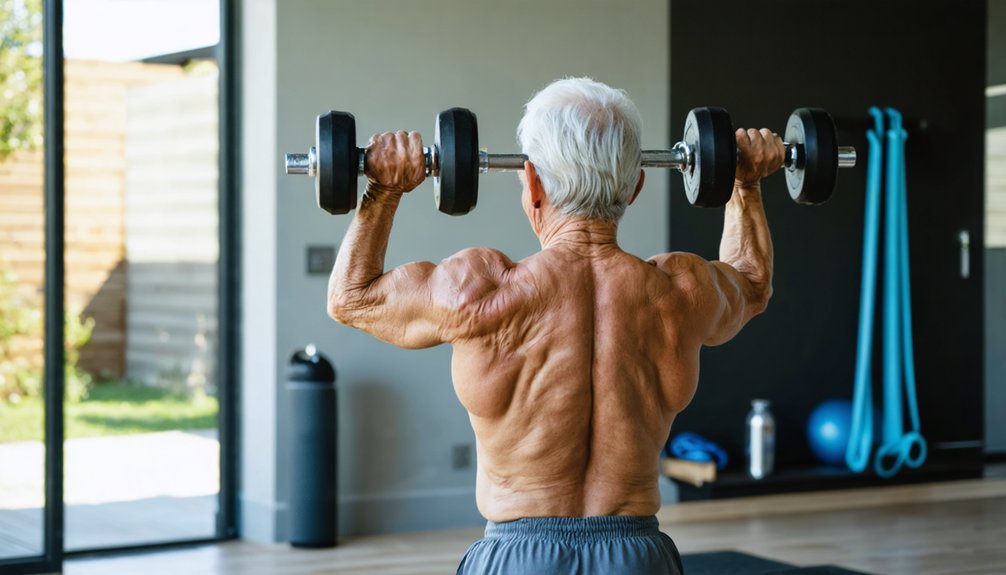

Strength training supports healthy aging by slowing age-related muscle loss, improving bone density, and enhancing balance, mobility, and daily function. It also improves insulin sensitivity, blood pressure, and body composition, while studies link even modest weekly amounts to lower risks of all-cause, cardiovascular, and cancer mortality. For many older adults, two weekly sessions targeting major muscle groups provide meaningful benefits when performed safely and progressively. The sections below explain the evidence, ideal dose, and safe starting approach.
Highlights
- Strength training slows age-related muscle loss, preserves mobility, and helps older adults maintain independence in daily activities.
- It increases bone-loading forces, helping slow bone loss and improve bone density at key fracture-prone sites.
- Better strength and core stability improve balance, gait, and coordination, reducing fall risk and functional decline.
- Regular resistance training improves insulin sensitivity, blood pressure, body composition, and is linked to lower all-cause mortality.
- Just two weekly sessions can deliver meaningful benefits when progressed safely with proper form, recovery, and supervision if needed.
How Strength Training Fights Age-Related Muscle Loss
Preserving muscle becomes increasingly important with age because sarcopenia—the progressive loss of muscle mass and strength—begins as early as the fourth decade of life, when muscle mass typically starts to decline by about 3 to 5 percent per decade. Symptoms can include weakness, fatigue, low energy, and difficulty with everyday movements such as standing, walking, or climbing stairs, all common signs of sarcopenia impact.
Resistance training directly counters this process by applying repeated overload that stimulates repair, supports muscle metabolism, and improves body composition. Adequate carbohydrate intake also helps preserve muscle by supplying the body’s primary energy source and reducing the need to break down muscle tissue for fuel. It also enhances neural activation, helping older adults produce force more efficiently despite age-related declines. Performing strength sessions 2 to 4 times per week helps reinforce these adaptations and supports muscle preservation.
Evidence shows this approach works. Progressive resistance exercise is the most effective intervention for slowing sarcopenia, improving strength, and supporting mobility.
In very old adults, high-intensity training has produced major gains in strength and walking ability within weeks.
With consistent practice, people can maintain capability, confidence, and independence while staying engaged in the activities and communities that matter most.
Why Strength Training Helps Keep Bones Strong
Two related mechanisms explain why strength training helps keep bones strong: mechanical loading and biological adaptation.
During resistance exercise, muscle contractions place targeted stress on bone, creating osteoblast stimulus and density stimulation that support bone remodeling. This process helps counter the bone turnover decline associated with aging.
Multi-joint lifts such as squats and deadlifts are especially effective because they increase loading density across major skeletal sites, promoting trabecular thickening, cortical fortification, and greater skeletal strength. Squats and deadlifts can also improve bone density in the hips and lumbar spine through targeted loading.
Evidence indicates regular training supports bone density and BMD preservation, particularly after age 50, when bone loss accelerates. Weight-bearing activities like walking or running can complement resistance exercise by adding bone stress that further supports bone health.
Moderate- to high-load protocols, often performed three times weekly, have been shown to slow annual decline and sometimes produce measurable gains at the spine, hip, and femoral neck.
This shared, practical strategy helps many older adults protect bone health and lower osteoporosis-related fracture risk over time.
How Strength Training Improves Balance and Mobility
Strength training also improves balance and mobility by enhancing the neuromuscular systems that control posture, gait, and coordinated movement. Research shows that core stability training improves fluid balance, with better Functional Reach Test performance, stronger trunk muscles, and faster postural adjustments during instability. Combined balance-strength programs further improve static balance by reducing sway, improving weight distribution, and compensating for age-related sensory decline. In a 12-week randomized study of older women with a history of falls, combined training improved balance and muscle strength measures, including sit-to-stand performance, weight-bearing squat control, gait parameters, and POMA scores.
These adaptations translate into measurable functional gains. Strength-based interventions improve Timed Up and Go, One-Leg Stand, and gait assessments, while inertial methods increase gait speed and support gait enhancement. In nursing-home residents, six weeks of inertial exercise produced Tinetti gains, with balance scores rising 29% and gait scores improving 18.6%. Functional resistance training also improves movement quality, lowers fall risk, and reduces lower back pain. Together, these findings show that well-designed strength training helps older adults move with greater confidence, steadiness, and independence in everyday environments and social settings.
Why Strength Training Lowers Disease and Death Risk
Why does this matter beyond mobility and independence? Evidence indicates that strength training is associated with lower risk of major chronic disease and premature death.
Across large cohorts, any resistance training is linked to about 15% lower all-cause mortality, with strongest reductions appearing around 30 to 60 minutes weekly. Dose-response analyses suggest peak benefit occurs at about 60 minutes per week, with no clear added advantage beyond that amount. U.S. guidelines also advise training all major muscle groups twice weekly. Combined aerobic and resistance exercise is associated with about a 40% lower risk of all-cause mortality.
Cardiovascular mortality falls by roughly 19%, and cancer mortality by about 14%, with benefits strongest when strength work complements aerobic activity.
These effects likely reflect more than muscle hypertrophy alone. Strength training improves metabolic health, insulin sensitivity, blood pressure regulation, and body composition, all of which influence disease risk over time.
For older adults seeking healthy aging within a supportive community, this evidence reinforces that regular muscle‑strengthening exercise is a meaningful, research‑backed way to protect long‑term health and longevity.
How Much Strength Training Supports Healthy Aging
How much strength training is enough to support healthy aging? Evidence indicates that most older adults benefit from two nonconsecutive resistance‑training sessions weekly. This frequency aligns with major guidelines and appears sufficient for muscle strength, muscle endurance, physical function, and metabolic health. Research also shows that once‑weekly training can improve strength, but two sessions generally provide broader, more reliable benefits. Scheduling these sessions on nonconsecutive days helps allow the 48 to 72 hours of recovery needed for muscle remodeling and strength gains.
Across studies, about 30 to 60 minutes per week delivers meaningful results, with roughly 60 minutes linked to optimal mortality reduction. Typical sessions last 30 to 45 minutes, including warm‑up. A practical dose is one to three sets for six to ten exercises covering major muscle groups, often using 10 to 15 repetitions initially. A recent meta-analysis in Sports Medicine found that one set can be sufficient for healthy adults over 60 to significantly improve muscle mass and strength. Volumes above 150 minutes weekly show no added advantage and may increase risk in some populations. For many older adults, starting with light resistance helps build confidence while reinforcing proper form and safety.
How to Start Strength Training Safely After 50
Before beginning a resistance-training program after 50, a medical evaluation is advisable to confirm that exercise is appropriate and to identify any unstable conditions that require modification.
Screened adults, including those with hypertension or COPD, can often train safely within established safety guidelines, and even frail individuals may tolerate appropriately supervised loading.
Certified trainers with senior-fitness expertise help create individualized plans, reinforce technique, and address fear, pain, or fatigue. Strength training can help preserve function and support independent living as people age.
Most programs start with light resistance, 1-3 sets of 6-15 repetitions, and progression strategies based on symptom response and form quality.
An upright posture, controlled lowering phase, exhaling during exertion, and careful attention to shoulders, hips, knees, and spine reduce risk.
A 10-minute warm-up and cool-down, stretching, core work, and training at least twice weekly support safe participation for many older adults.
How to Combine Strength Training With Cardio
Balance matters when combining strength training with cardio in later life. Evidence indicates concurrent training supports healthy aging without reducing lower-body strength, lean mass, or hypertrophy compared with resistance exercise alone.
Studies also show exercise order has little effect, so cardio scheduling can reflect preference, recovery, and consistency.
A practical approach pairs moderate aerobic work with resistance sessions three times weekly, or uses separate days when fatigue is higher.
This combination improves blood pressure, LDL cholesterol, blood sugar, body composition, cardiorespiratory fitness, and muscular strength.
It also preserves lean mass during fat loss more effectively than cardio alone.
For time efficiency, interval training that blends short aerobic bouts with strength circuits can fit into 20 to 30 minutes.
Such routines support adherence, mobility, joint stability, and a shared sense of progress.
References
- https://pmc.ncbi.nlm.nih.gov/articles/PMC10199130/
- https://www.uclahealth.org/news/article/why-strength-training-critical-older-adults
- https://www.health.harvard.edu/healthy-aging-and-longevity/strength-training-might-lengthen-life
- https://medicalxpress.com/news/2026-03-strength-key-healthy-aging.html
- https://time.com/7323121/strength-training-exercises-aging-health-benefits/
- https://www.psu.edu/news/research/story/strength-training-helps-older-adults-live-longer
- https://www.nia.nih.gov/news/how-can-strength-training-build-healthier-bodies-we-age
- https://health.osu.edu/wellness/exercise-and-nutrition/preventing-muscle-loss-as-we-age
- https://www.cdc.gov/physicalactivity/downloads/growing_stronger.pdf
- https://www.health.harvard.edu/diet-and-nutrition/beyond-protein-6-other-nutrients-that-help-prevent-muscle-loss