

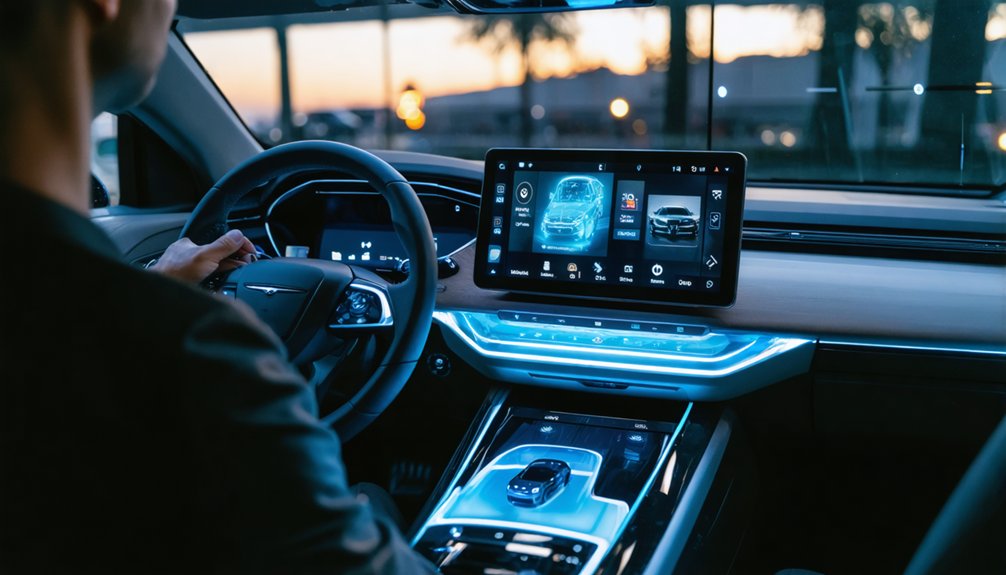

Vehicle software now plays a major role in car buying because it affects safety, convenience, long-term value, and brand trust. Buyers increasingly judge vehicles by driver-assist systems, interface quality, privacy practices, and whether over-the-air updates will keep features current after purchase. Software can improve crash prevention, battery efficiency, navigation, and maintenance planning, but it can also add subscriptions and repair costs. The points below show which software qualities matter most before committing.
Highlights
- Vehicle software now shapes buying decisions because most shoppers research online, and AI tools increasingly influence which cars they consider and trust.
- Safety software like collision warnings, emergency braking, and stability control can significantly reduce crashes, injuries, and fatal accidents.
- OTA updates keep vehicles improving after purchase, adding features, fixing software issues remotely, and encouraging owners to keep cars longer.
- Software quality affects total ownership cost through subscriptions, connected services, repair complexity, insurance impacts, and maintenance planning.
- Buyers increasingly judge vehicles by software transparency, privacy practices, interface quality, and whether key features are included or paywalled.
Why Vehicle Software Changes the Buying Decision
As vehicle software becomes more influential in the shopping process, it increasingly shapes how buyers narrow options, compare models, and approach the final purchase decision. With 92% of consumers researching vehicles online before purchase, software now plays a central role in digital-first shopping.
Research shows 97% of AI users say it affects purchases, while 44% of consumers have used AI-powered tools for car shopping. These tools translate natural questions into targeted results, saving time for 73% of users and helping shoppers feel better prepared. Many also continue their research beyond AI, with 41% visiting dealer or manufacturer sites after an initial answer, showing the importance of next-step research.
Vehicle software also changes expectations around software integration, personalization, and ongoing ownership value. Buyers increasingly rely on digital guidance before visiting dealers, yet many still verify recommendations through trusted sites and retailer input. Even so, 30% of shoppers say an AI response is enough on its own, underscoring software’s role as a decision shortcut.
Confidence is growing, not unconditional: 71% report moderate trust in AI, while concerns about bias and data privacy remain. In that environment, software becomes part of how informed buyers feel confident, included, and ready.
Which Vehicle Software Features Matter Most?
What matters most to buyers is not software in the abstract, but the specific features that improve safety, convenience, and long-term ownership value.
Strongest interest centers on safety systems: driver monitoring, alcohol detection, AI-assisted support, and advanced suites such as Toyota Safety Sense 4.0. These tools help drivers feel protected and aligned with rising safety expectations. Buyers are also increasingly drawn to vehicles that support continuous upgrades through software-defined architectures, extending functionality and value over time. Aftermarket safety tech that adds lane-departure, forward-collision, blind-spot, and parking alerts also appeals to shoppers seeking ADAS add-ons for older vehicles. OTA updates also matter because 52% of U.S. respondents said regular OTA updates would make them keep a vehicle longer.
Convenience follows closely. A Predictive co‑pilot that handles routing, maintenance questions, energy management, and voice shortcuts makes daily driving simpler and safer.
Buyers also respond to an Adaptive cockpit that remembers seating, climate, and display preferences while enabling natural, hands-free interaction.
Infotainment still matters, especially large touchscreens, smartphone integration, and premium audio.
Finally, vehicle-health monitoring, including tire-pressure and battery tracking, adds reassurance by helping owners avoid breakdowns and preserve value.
How OTA Updates Make Cars Better Over Time
How do over-the-air updates make a vehicle more precious after it leaves the showroom? They turn ownership into an ongoing relationship, allowing vehicles to improve with the community’s expectations rather than age in place.
Automakers now enhance guidance, voice assistants, energy management, and even acceleration or driving range remotely, helping cars feel current longer. For many brands, recall-by-update has also become a practical way to fix urgent software-related issues without requiring every owner to visit a dealership.
That practical value explains why the OTA market is expanding rapidly and why adoption grew from 33 U.S. models in 2018 to more than 300 by 2023. The market is projected to reach USD 15.75 billion by 2030, highlighting rapid OTA growth.
Owners increasingly expect convenience without dealership visits, while manufacturers gain real-time diagnostics and product understanding. Some OTA improvements can even boost EV range and battery efficiency, reinforcing software as a source of core value.
This supports future roadmap personalization, more relevant features, and stronger OTA longevity.
For buyers, the appeal is clear: a vehicle can continue changing to match how modern drivers live and connect together.
Why Vehicle Software Now Affects Safety
Increasingly, vehicle software shapes safety outcomes just as much as hardware. Modern driver-assistance systems depend on accurate sensing, rapid processing, and reliable decision logic. Research shows Forward Collision Warning reduces rear-end crashes by 27% and injuries by 20%, while stronger warning integration can halve crashes and cut injuries by 56%. Electronic Stability Control, a software-driven system now mandatory on new vehicles, has been shown to reduce single-vehicle fatal crashes by 40% to 56% through automatic vehicle stability intervention. Since backup cameras have been mandatory on vehicles built after May 2018, rear-view video technology has become another software-linked safety feature buyers should evaluate.
Automated Emergency Braking extends that protection, though performance weakens at night, in bad weather, and around curves. This makes software safety and firmware compatibility central concerns, not technical footnotes. Waymo reports 82% fewer injury crashes than human benchmarks across its operating areas, reinforcing how software performance now directly affects real-world safety outcomes.
Long-range projections reinforce that shift. AAA Foundation estimates ADAS could prevent millions of crashes and roughly 250,000 deaths through 2050. Real-world autonomous data also signals progress: Waymo reports 82% fewer injury crashes and 92% fewer pedestrian injury crashes. For buyers, safer mobility increasingly means joining a software-defined driving environment.
How Vehicle Software Shapes Ownership Costs
Two cost curves now define vehicle ownership: the familiar expenses of fuel, insurance, and routine service, and a faster-rising layer tied to software, sensors, connectivity, and digital features.
Annual ownership now exceeds $7,300 for many drivers, while maintenance, repairs, and tires alone average about $1,656 a year. Drivers also routinely underestimate true ownership costs, often budgeting far below what they actually spend each year. USDOT data also shows that total ownership costs climbed from $2,154 in 1975 to $12,296 in 2024 in 2026 dollars. With inflation still above targets, monthly car costs remain under pressure even when financing conditions appear stable.
Sensor-rich glass, recalibration, and advanced diagnostics raise repair bills and insurance premiums.
OTA updates can lower warranty expense and preserve performance, yet they also support subscriptions, software licensing, and recurring paid upgrades.
As vehicles stay on the road longer, cumulative costs compound across service visits, inflation, and digital feature fees.
Predictive diagnostics and connected maintenance can improve planning, but they also expand lifecycle spending and introduce practical concerns around data privacy, especially as more owners depend on always-connected systems daily.
What Vehicle Software Says About Brand Trust
Although powertrain specs and price still matter, vehicle software now functions as a visible proxy for brand trust. Regular updates signal long term commitment; the OTA impact is clear when 52% of U.S. drivers say they would keep a vehicle longer with ongoing improvements. Software reliability also shapes reputation, especially in safety integration and security features such as anti theft tracking.
Trust strengthens when brands pair performance with data transparency, giving drivers control over what is collected, used, or deleted. That openness can outweigh cost implications, as many consumers will pay more when confidence is established. Yet brand trust also depends on regional expectations: local language voice control matters far more in China and India than in the U.S. Increasingly, trust grows from practical value rather than feature comparison alone.
How to Compare Vehicle Software Before You Buy
Before comparing horsepower or trim packages, buyers should evaluate how the vehicle’s software performs in daily ownership and how well it will improve over time.
They should compare OTA update support, since 52% of U.S. consumers keep vehicles longer when updates arrive regularly, improving safety, performance, and long-term value.
They should also assess the User interface, embedded connectivity, and smartphone-style infotainment, now expected in modern vehicles.
Android Automotive OS, AI-based climate and seating adjustments, and V2X features can signal a more capable platform.
Safety software deserves close attention, especially systems using edge AI for real-time decisions.
Buyers should ask whether features are included or locked behind subscriptions, as affordability matters.
Finally, Data privacy practices and secure data management should be reviewed carefully, because trust increasingly defines which ownership experience feels future‑ready.
References
- https://www.techarena.ai/content/predictions-for-2026-three-forces-disrupting-vehicle-development
- https://www.thebuzzevnews.com/deloitte-consumer-study-2026/
- https://www.spglobal.com/automotive-insights/en/blogs/2026/01/automotive-market-trends-2026
- https://www.deloitte.com/us/en/Industries/consumer/articles/global-automotive-consumer-study.html
- https://www.acvmax.com/blog/automotive-technology-trends
- https://www.coxautoinc.eu/news-insights/automotive-industry-trends-2026/
- https://www.cbtnews.com/vehicle-dependability-declines-jd-power-2026/
- https://investor.cars.com/2025-11-20-Cars-com-Survey-Reveals-AIs-Growing-Influence-on-Car-Shopping-97-of-AI-Users-Say-it-Will-Impact-Purchase-Decisions-and-Almost-Half-Have-Already-Leveraged-the-Tech-for-Car-Shopping
- https://digitaldealer.com/news/ais-influence-on-car-shopping-skyrockets-new-survey-reveals/168732/
- https://www.demandlocal.com/blog/vehicle-purchase-decision-statistics/